
English| EUR
Suggested for you
More currencies
Choose a language
October marks the transition from summer dispersal to winter congregation for Florida's manatee population. Water temperatures shift just enough to draw the first individuals back to warm-water refuges, though peak numbers won't arrive until December. Knowing what October offers helps set realistic expectations for your visit.
Quick answer
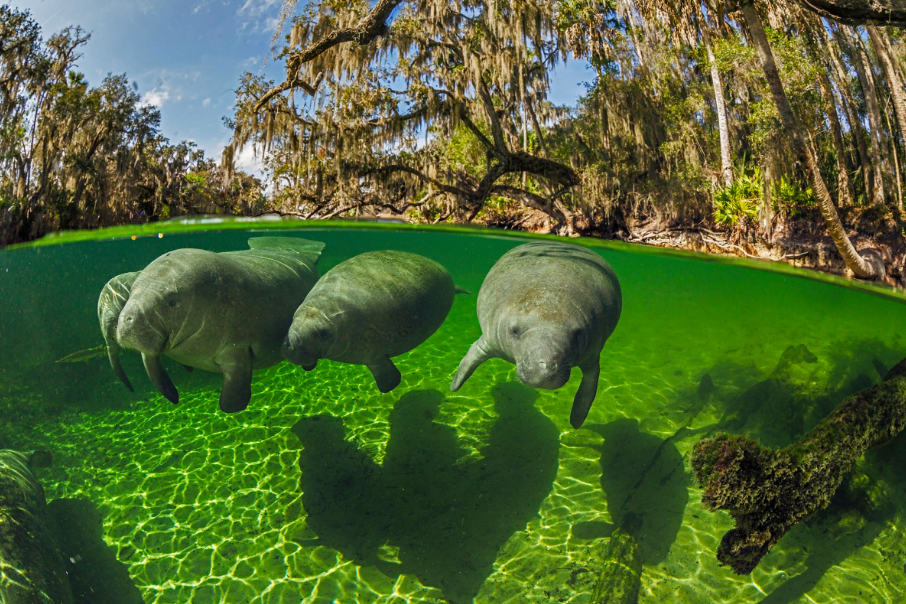
Yes, you can see manatees in Florida in October, particularly at Blue Spring State Park near Orlando. Early October typically sees 5 to 15 manatees as Gulf and river temperatures begin cooling, with numbers climbing toward 30 or more by month's end when cold fronts push through. Sightings are far from guaranteed compared to winter's reliable congregations, but the animals you do see tend to be active and approachable in the still-warm spring water.
Blue Spring maintains a constant 72°F year-round, a temperature that becomes critically important once surrounding waters drop below 68°F. October sits at the threshold — the St. Johns River hovers between 75°F and 80°F through most of the month, warm enough that manatees continue ranging freely along the coast and through tributary systems. Cold fronts change the equation overnight, sending the first wave of migrants into the spring run where they'll remain until temperatures stabilize. Whether you can see manatees in Florida in October depends largely on weather patterns in the two weeks before your visit. A string of cool nights in late September will accelerate arrivals, while an extended warm spell keeps animals dispersed. The park's daily manatee count, posted each morning, reflects these fluctuations — single digits one day, two dozen the next. Unlike January's guaranteed crowds of 400-plus manatees, October rewards patience and flexibility. Arrive during the park's 8:00 AM opening to secure entry before capacity closures, then position yourself along the spring run boardwalk where visibility reaches 30 feet into the water column. The animals present in October display different behavior than their lethargic winter counterparts. With ample food still available in the river system, manatees move in and out of the spring throughout the day rather than settling into dense rafts. You'll see individuals swimming actively, investigating the boardwalk pilings, and occasionally breaking the surface with audible exhalations. Calves born in spring now weigh 600 pounds and exhibit growing independence from their mothers, offering clear views of social dynamics that winter crowding obscures. Manatee viewing in October combines the accessibility of Blue Spring's infrastructure with the intimacy of lower visitation. The $6 vehicle entrance fee grants access to boardwalks, observation platforms, and ranger-led programs that contextualize what you're seeing. Water clarity peaks in fall before winter rains bring tannins downstream, making October one of the clearest months for underwater observation despite lower manatee numbers.
“October rewards patience and flexibility — single digits one day, two dozen the next, depending entirely on cold fronts that push animals into warm-water refuges.”
Manatees reside in Florida year-round, though October represents a transitional period as cooling waters prompt them to migrate toward reliable warm-water refuges like Blue Spring. While sightings are less frequent than during peak winter months, visitors often observe early arrivals as temperatures drop.
Warm, 80-85°F
Manatees are primarily located in deeper river channels during this warmer phase.
Cooling, 75-80°F
As temperatures fall, manatees begin moving toward warmer springs.
—
Reduced visitor volume provides a quieter environment for spotting wildlife in the water.
Verdict: The best opportunity to observe early seasonal movement is during weekday mornings in late October as manatees begin seeking warmer spring waters.
Blue Spring State Park operates on a consistent schedule throughout the week, providing steady access for visitors planning their trips in October.
Entrance fees at Blue Spring State Park are structured based on the type of entry, whether by vehicle, as a single occupant, or as a pedestrian or cyclist.
Verdict: A typical adult visitor pays between 2 USD and 6 USD, with the total cost depending on your method of arrival and the number of passengers.
Blue Spring State Park is located at 2100 W French Ave, Orange City, FL 32763. The most direct approach for visitors traveling from the Orlando area is by car via I-4 East.
I-4 East to exit 114, then follow signs to W French Ave
Direct service from Orlando area to 2100 W French Ave
The park frequently reaches capacity and closes to incoming traffic. Arriving within the best arrival window of 08:00–10:00 is essential to ensure your entry.
Managing your expectations and behavior is key to successful manatee observation during the transition into autumn.
Resist the urge to enter the water if manatees are present to avoid disrupting their natural behavior. Viewing from the elevated boardwalks provides a clear vantage point without encroaching on their space.
Manatees are sensitive to sudden noise and movement which can cause them to leave the area. Maintain a low profile and minimize talking while scanning the water's surface for their snouts.
Surface glare often hides manatees resting just below the water line. Polarized lenses significantly improve your ability to spot them in the shifting light of October afternoons.
Look for circular calm spots on the water's surface, known as footprints, which indicate a manatee is swimming just below. These patterns are often the first sign of activity before the animal surfaces to breathe.
In early autumn, manatees remain active throughout the wider river systems rather than congregating solely at spring heads. Check local water conditions to understand if the animals are dispersed or beginning their seasonal movement toward warmer spring waters.
Everything you need to know about can you see manatees in florida in october
While manatees are present in Florida waters year-round, they are less concentrated in spring-fed runs during October compared to the colder winter months. You may still spot them in the St. Johns River system, but large aggregations are more common when temperatures drop.
Booking a guided kayak excursion is an effective way to explore the waterways near Orlando. These tours provide professional insight into the local ecosystem and increase your chances of spotting wildlife in their natural habitat.
The peak viewing season for these marine mammals typically begins in November and extends through March. During these months, manatees seek out the constant 72-degree water of natural springs to stay warm.
Swimming with manatees is restricted in many protected areas to ensure the safety of the animals. It is always best to maintain a respectful distance and observe from a kayak or designated viewing platform.
To ensure entry, you should arrive between 08:00 and 10:00 as the park frequently reaches capacity. Arriving early is essential to avoid being turned away due to overcrowding.
Yes, can you see manatees in florida in october during a guided kayak tour by paddling through quiet, natural waterways. Your guide will know the best locations to spot these gentle creatures as they travel through the river system.
The entrance fee is 6 USD per vehicle for up to 8 people, 4 USD for a single-occupant vehicle, and 2 USD for pedestrians or cyclists. These fees help maintain the park's facilities and conservation efforts.
If the weather remains warm in October, manatees remain dispersed throughout the open river rather than congregating in the springs. Because can you see manatees in florida in october is subject to these environmental factors, sightings are never guaranteed.